There are times during the semester when student engagement declines–midterms, major project deadlines, or a struggle to balance the work of multiple courses. To ensure that students remain motivated to keep coming to class, Mariana Castro Azpíroz and Saime Esma Masca share activities to encourage students not to miss their ENGL 1500/2500 sessions. They provide creative ways to anchor students, encourage belonging, and foster continuous learning.
Mariana’s activity, “Bingo Card,” provides students with a fun way to set goals toward growth in writing and communication skills, as well as strengthen the classroom community. The openness of the activity allows for student choice while promoting accountability.
Esma’s activity, “Visual Journal,” fosters engagement through visual texts and builds a collection that can serve as a multimodal study guide of course concepts, not only through individual student submissions, but created collectively as a class.
Below, you can find Mariana and Esma’s activities as detailed lesson plans.
Bingo Card
Purpose of the activity: To create a space to keep track of a set of goals throughout the semester, motivating students to keep coming to class. To encourage students to set their own objectives to help them grow as writers, communicators, classmates, and students.
Activity from English 2500 Honors section used with student’s permission
Create a blank bingo template and fill in the first row with goals that you think would foster a sense of community within your classroom (e.g. learn the names of all your classmates) or promote attendance and participation (e.g. share your insight during a class discussion).
Add optional activities that would be useful for students and would promote engagement with university resources (e.g. schedule an appointment at the writing center) or could enhance their major assignments (e.g. give your essay a creative title).
Print out the templates, leaving at least half of the spaces blank for students to personalize.
Hand out a bingo template to each student and ask them to fill it out with initial goals either at the beginning of the semester or during the transition between the first and second units. Include both of the following:
Writing and communication goals for the semester as a whole
Other personal goals as a student (e.g. meeting deadlines, attending class, contributing to class discussion)
Note: if the squares are too small, it might be best to create a key or to label the spaces with letters or numbers and then write the goals below. Encourage students to customize their bingo cards by color-coding goals by category or decorating the template in whichever way they like with colors, markers, stickers, etc.
Throughout the semester, as you explain each new major assignment, ask students to add a number of specific goals that they would like to work on during the unit. This can also be done during the reflection part of the unit, as the students look back on the work they have completed and look forward to new goals.
In the final session of the semester, have the students see how many bingos they can make on their card (you may decide to offer extra credit or some other form of treat or prize to celebrate). Reflect upon skills gained, achievements, and accountability.
Visual Journal
Purpose of activity: To encourage students to engage creatively with course concepts by pairing visual materials with reflection, helping them internalize and retain writing strategies in a multimodal format.
Materials or resources needed:
A shared digital platform (e.g., Notion, Padlet, or other unlimited gallery tool) where students can post images, memes, or short embedded media
Weekly prompts
Description of the activity:
Instructor created example for activity, used with permission
Once per week, at the end of class, the instructor provides a prompt for a visual response (e.g., “Find a meme that illustrates a common logical fallacy” or “Locate an image that represents your profile subject’s dominant impression.”)
Students spend ~10 minutes finding and posting one visual that responds to the weekly prompt.
Acceptable visuals include memes, images or photographs, GIFs, short video clips (from YouTube, TikTok, etc.), posters or infographics, cartoons or comics, screenshots of social media posts or ads, and simple sketches or doodles (digital or hand-drawn and photographed), but students are not limited to these options.
Alongside the visual, students add a short caption or comment (2–3 sentences) explaining how their chosen image connects to the course concept or assignment they’re working on.
At the end of each unit, students create and share one original visual (poster, infographic, meme, or simple sketch etc.) that synthesizes what they learned.
The visuals are collected in the digital platform so students can review them throughout the semester as a multimodal study guide.
Potential adaptations:
For ENGL 1500 (Personal Narrative, Profile, Multimodal Remix): prompts can emphasize personal storytelling and multimodal awareness (e.g., images that represent a turning point in a personal narrative, or design elements for the remix).
For ENGL 2500 (Argument, Analysis, Research): prompts can emphasize rhetorical strategies and argument-building (e.g., images that illustrate ethos/pathos/logos, or memes that parody weak arguments).
Instructors may invite students to “like” or comment on one peer’s visual each week, creating a low-stakes peer feedback loop.

 Bingo Card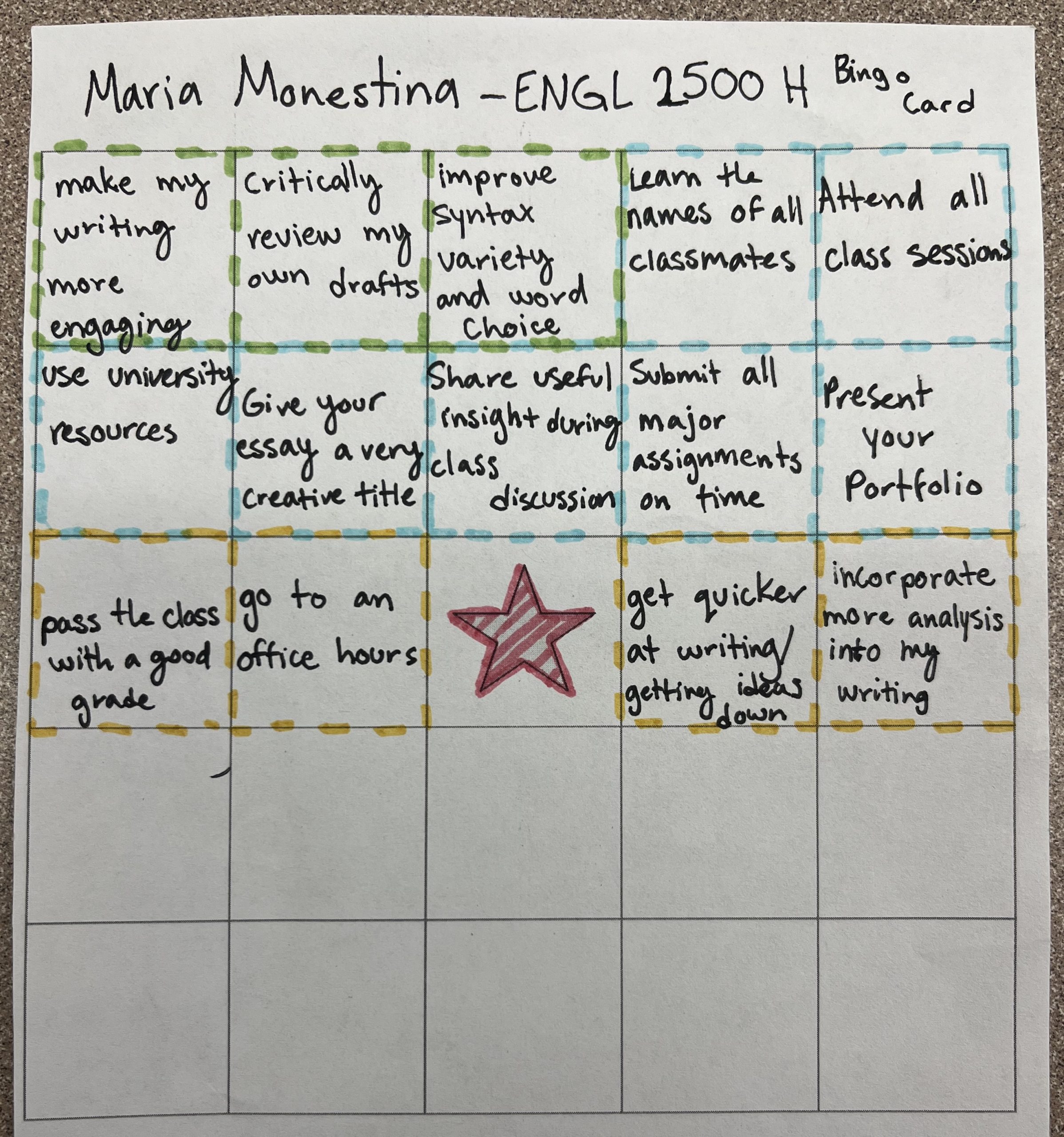
 Visual Journal