MFA Program in Creative Writing and Environment
A three-year writing program that explores the inherent connections between the human story and the imprint of place and the natural world on the literary works we create.

From Homer's Odyssey to Melville's Moby Dick, from Black Elk to Black Boy, from Virginia Woolf to Tobias Wolff, the literary arts acknowledge an inherent connection between the imprint of place and environment on the stories and images that shape the work of literary writers.
Iowa State University's three-year MFA Program in Creative Writing and Environment emphasizes creative writing—poetry, fiction, nonfiction, and drama—that encourages writers to identify and explore in their stories and lyric impressions the complex influences of place, the natural world, and the environmental imagination.
The human story finds its structure in geology and geography, in biology and chemistry—both natural and constructed—and in the complex and rapidly-changing cultural and natural landscape. With more people sharing our planet’s finite space, and with our planet and its systems imperiled, an educated attention to place in the broadest sense of the term is vital.
Through a program of study that includes a rigorous combination of creative writing workshops, literature coursework, fieldwork experience, cross-disciplinary study in disciplines other than English, and intensive one-on-one work with a major professor, our MFA program offers gifted writers an original and intensive opportunity to document, meditate on, mourn, and celebrate the complexities of our transforming natural world.
Students in this MFA program will:
- learn to write with skill and knowledge about place as a personal, political, and natural manifestation;
- gain a cultural-historical understanding of environmental complexity through cross-disciplinary coursework;
- become familiar with literary works that expand environmental and place-based consciousness;
- produce publishable creative works in workshops and master classes;
- utilize critical insight to evaluate their own writing and the writing of others
- receive experience and training in editing and publishing through participation with Flyway: Journal of Writing and Environment;
- benefit from practical real-world experience through fieldwork and internship opportunities;
- complete a book-length manuscript of publishable quality under the guidance of a major professor.
General Information About Creative Writing at ISU and the Ames Community
Financial Support for Graduate Study
Applicants to the MFA Program in Creative Writing and Environment are encouraged to seek financial support by applying for both a Teaching Assistantship and the Pearl Hogrefe Fellowship in Creative Writing.
MFA Creative Writing Faculty
The graduate faculty in Creative Writing includes:
- Dean Bakopoulos
- Barbara Haas
- Debra Marquart
- Benjamin Percy
- Stephen Pett
- Mary Swander
- David Zimmerman
- Linda Hasselstrom (Visiting)
- Heather Derr-Smith (Visiting, Spring '09)
Recent Visiting Writers
Adrienne Rich ≈ Li-Young Lee ≈ Linda Hogan ≈ Ted Kooser ≈ Barry Lopez ≈ Richard Manning ≈ Steve Almond ≈ Michael Martone ≈ Bernard Maclaverty ≈ Joy Harjo ≈ Dan O'Brien ≈ Annie Proulx ≈ Brenda Peterson ≈ Gary Snyder ≈ Scott Russell Sanders ≈ Debra Gwartney ≈ Osha Gray Davidson ≈ Michael Pollan ≈ Sheryl St. Germain ≈ Gary Soto ≈ Allison Hedge Coke ≈ Sandra Steingraber ≈ Alexandra Fuller ≈ Wendell Berry ≈ David Shields ≈ Charles Baxter ≈ William Kittredge ≈ Annick Smith ≈ Jennifer Kwon Dobbs ≈ Bill McKibben ≈ Gina Oschner
Publications and Conferences
- Iowa State University is home to the environmental literary journal Flyway: Journal of Writing and Environment. MFA students will be invited to staff Flyway's editorial positions.
- Each spring Iowa State’s Creative Writing Faculty hosts a three-day Symposium on Wildness, Wilderness & the Creative Imagination.
MFA Program of Study Requirements
TWELVE CREDITS IN CREATIVE WRITING WORKSHOPS:
Students may choose from the following, and may repeat any up to a maximum of 12 credits for each course. Every genre workshop offers a component on environmental or place-based creative writing.
- English 550: The Study of Craft: Poetry, Fiction and Nonfiction--taken in first semester
- English 551: Master Workshop--advance work on thesis, taken in fourth semester
- English 553: Advanced Imaginative Writing: The Long Project
- English 554: Advanced Imaginative Writing: Fiction
- English 555: Advanced Imaginative Writing: Nonfiction
- English 556: Advanced Imaginative Writing: Poetry
- Students may choose to substitute one of our study–abroad creative writing courses (currently we offer Ireland, Trinidad and Tobago) for one of the genre workshops.
SIX CREDITS OF ELECTIVES IN CREATIVE WRITING:
Students may choose from the following:
- English 552: Literary Editing and Publishing
- English 557: Studies in Creative Writing. This course will be taught once a year on topics related to place and environment. “Travel Writing,” “Imagining the Natural World,” “Infected by Place,” and “(Re)Writing the West” are topics taught recently.
- English 558: Teaching Creative Writing
- English 559: Creative Writing Teaching Internship
- English 589: Supervised Practicum in Literary Editing
THREE ENGLISH LITERATURE CREDITS WITH AN EXCLUSIVELY ENVIRONMENTAL FOCUS:
- English 543: Environmental Literature--taken in the second semester
FIFTEEN CREDITS IN ENVIRONMENTAL COURSES OUTSIDE OF ENGLISH:
Students may choose, in consultation with their advisor, from any Iowa State courses available for non-major graduate credit with an environmental focus. (Click here to Download Petition form.) BELOW ARE A FEW EXAMPLES OF POSSIBLE COURSES:
-
Anthro 516: Environmental Archaeology
- Anthro 518: Global Culture, Consumption and Modernity
- Anthro 520: Cultural Continuity and Change in the Prairie-Plains
- Art H 580: North American Indian Art
- Art H 582: Art and Architecture of Asia
- Arch 528: Reading-Writing Places
- Env S 334, same as PHIL 334: Environmental Ethics
- Env S 472, same as HIST 472: American Environmental History
- Env S 384,same as Relig 384: Religion and Ecology
- Env S 404, same as AGRON 404: Global Change
- Env S 407, same as NREM 407: Watershed Management
- Env S 460, same as NREM 460: Controversies in Renewable Resource Management
- Env S 482, same as POL S 482: Environmental Politics and Policies
- JI MC 547: Science Communication
- Ling 500: same as Anthro 500) Language and Culture
- Psych 488: Cultural Psychology
- Relig 372/AST 372: World Religions and Sustainable Ag.
THREE CREDITS IN FIELD WORK: Students may repeat up to a maximum of 6 credits.
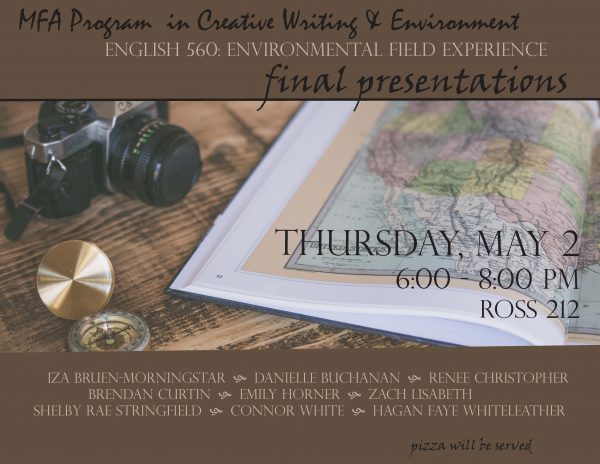
- English 560: Environmental Field Experience
SIX CREDITS IN LITERATURE COURSES:
- Electives in Literature
THREE CREDITS OPEN ELECTIVE IN ENGLISH:
- Open Elective in English Department course other than Creative Writing
SIX CREDITS THESIS WORK:
- English 699: Thesis/Research--intensive one-on-one thesis work with major professor.
TOTAL PROGRAM OF STUDY : 54 credits minimum
Program Application
Applicants must submit an electronic application for ISU graduate admission and mail required materials in order to complete an application. Please review the English Department graduate admissions application requirements for details regarding the following:
-
Online graduate application and fee.
-
Official transcripts from all undergraduate and graduate work.
-
GRE General Test official score report for an exam taken five years or less from the date of application.
- Cover letter (2 -3 pages) or statement of intent adressing reasons for applying to the MFA in Creative Writing and Environment. Be sure to include information about the creative writing projects you have completed or are currently working on, as well as any publications or prizes for creative work. In order to articulate how the MFA in Creative Writing and Environment suits your interests, experience, and creative projects, it's useful to touch on a few of the following topics:
1. Fieldwork experiences in natural or urban landscapes that have influenced your aesthetic;
2. Writers or currents of environmental thought that have influenced your work;
3. Issues of place, landscape, the natural world, or environment with which your work engages;
4. Organizations you've work with or activities related to environmental issues (if any);
5. Writing projects you can imagine tackling that have an environmental dimension.
NOTE: If you wish to be considered for a teaching assistantship, please include a mention in your cover letter of any teacher-training you've had, as well as any previous teaching, tutoring, and/or mentoring experience.
- Curriculum vitae or resume including educational background, awards, accomplishments, and teaching/tutoring experience.
-
Three letters of recommendation.
- Creative writing sample of no more than twenty-five pages (prose) or fifteen pages (poetry) demonstrating exemplary ability in one genre, although once admitted students will not be restricted to working in one genre.
-
Expository prose sample of scholarly writing (five to ten pages) displaying a command of accepted grammatical rules for written English and demonstrating critical and research skills. (Applicants typically submit a scholarly research essay they have produced for an undergraduate or graduate course in English.)
-
TOEFL or IELTS official score report (required only of non-native speaking applicants required by the ISU Admissions Office to submit TOEFL or IELTS scores). Minimum required scores: 100 IBT; 250 CBT; 600 PBT; 7.0 IELTS.
-
Audio or video file demonstrating competence in spoken English (required only of non-native speaking applicants required to submit TOEFL or IELTS scores).
Deadline for Application
- January 5th for entry the following fall semester
For More Information
-
Download a Short Description of Proposal for Iowa State University's MFA in Creative Writing and Environment.
-
For questions about the MFA Program application process, go to engl.iastate.edu/resources/graduate-studies/application-process/ or contact Teresa Smiley at englgrad@iastate.edu.
-
For questions about the MFA Program coursework or requirements, please contact Stephen Pett at spett@iastate.edu or Debra Marquart at marquart@iastate.edu.